Allocating work between people and automation
Before you design screens, consoles or rooms, you need to know what the system must do, who or what should do it, and what that means for the operators' jobs.
Part of the HF engineering process · steps 03 and 04The foundation of an integrated design
Function and task analysis should be carried out and documented to identify ergonomic needs, such as involvement, analysis and the solutions needed to reach the goals.
It supports an integrated design for your central control room by helping you:
- Define system performance
- Allocate functions to humans or machines (automation)
- Define task requirements
- Design the job organisation
- Verify and validate the results
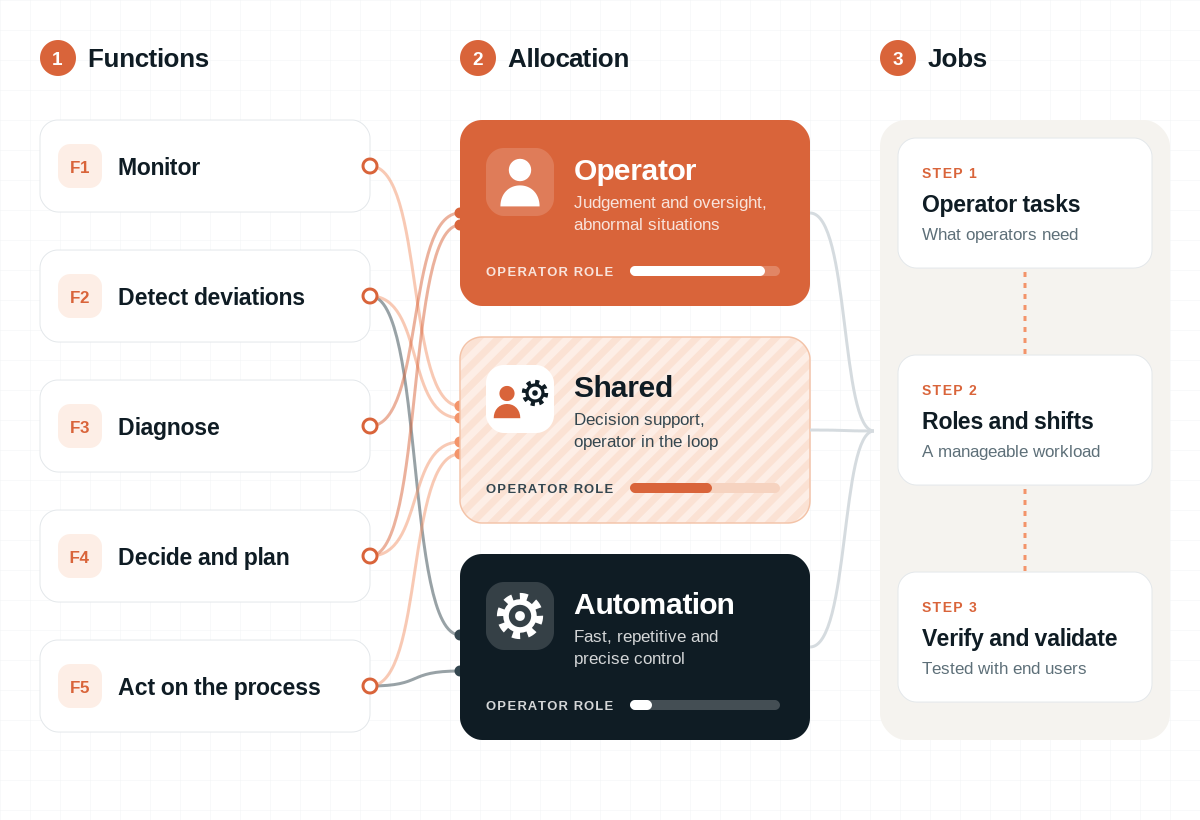
From system goals to operator jobs
Function and task analysis is part of the analysis and definition phase of ISO 11064. We work through it step by step, with your operators and engineers involved throughout.
Define system performance
We set out what the system must achieve, in normal operation and in abnormal situations.
Allocate functions
We decide which functions are best handled by people and which by automation.
Define task requirements
We describe the tasks operators carry out and the information, tools and time they need.
Design the job organisation
We group tasks into roles, shifts and teams that give a reasonable workload.
Verify and validate
We check the results against the requirements and test them with the end users.
What goes wrong without it
When work is split between people and automation without a clear analysis, the result is often a system that is hard to run safely.
Operators out of the loop
With too much automated, operators lose track of what the process is doing and struggle to take over when something goes wrong.
Overload and peaks
With too little support, or tasks bunched together, operators face more than they can handle during disturbances.
Unclear roles
When responsibilities are not defined, tasks fall between operators, shifts and control rooms.
Centralising control rooms or adding automation?
Tell us about your plans, and we'll help you decide what your operators should do and what the system should do for them.