All services Services · Control Room Design

Control rooms and control centres built on ISO 11064

Whether you are developing a new control room, consolidating several local control rooms into a central control centre (CCR), or upgrading an existing facility, Human Factors plays a critical role in ensuring safe, efficient and reliable operations.

At HF Specialist, we apply the principles of ISO 11064 to develop human-centred control room environments that support operational requirements, operator performance and long-term reliability.

Why Human Factors

A visually impressive control room is not necessarily an effective one

A modern control room is more than an attractive space filled with consoles, screens and advanced technology. Its effectiveness depends on how well the environment supports the people who operate it.

Human Factors ensures that control room design considers operator capabilities, limitations, tasks, workload and interaction with technology. Involving operators and other relevant stakeholders throughout the design process is essential to creating an environment that supports safe and effective operations.

Key stakeholders involved in the design process

  • Operators
  • Shift supervisors
  • Maintenance staff
  • DCS suppliers
  • Third-party consultants
Key challenges

Key challenges in modern control room projects

Industrial operations are changing rapidly. Centralisation, digitalisation and automation are transforming how control rooms are designed, organised and operated. While these developments create opportunities for improved efficiency and operational integration, they also introduce new Human Factors challenges.

HF Specialist helps organisations address these challenges by integrating Human Factors principles into control room projects from the early planning stages through design, implementation and evaluation.

01

Centralisation of control rooms

Consolidating multiple control rooms into a central control centre

Many organisations are moving from several geographically distributed local control rooms towards a centralised operating model, run from a central control centre (CCR). This transition involves much more than bringing operators together in one location. It also changes the relationship between central operators and the local operators and field personnel who remain at each facility.

It requires a fundamental review of operational functions, responsibilities, staffing levels, communication, task allocation and information flows between different facilities.

Key challenges include

  • Defining operational responsibilities and authority between the CCR and local facilities.
  • Understanding how centralisation affects operator workload and staffing requirements.
  • Maintaining situational awareness across multiple plants, processes and locations.
  • Designing workstations and control room layouts that support multiple operational functions.
  • Ensuring effective communication and coordination between central and local operators.
02

Digitalisation and technological transformation

Designing control rooms for an increasingly digitalised operating environment

Digitalisation is changing how operators access, interpret and interact with operational information. Advanced process visualisation, integrated control systems, large-screen displays, decision-support tools and digital workflows are becoming increasingly common.

However, introducing new technology does not automatically improve operational performance.

Key challenges include

  • Managing increasing volumes of operational information.
  • Ensuring consistent information presentation across different systems.
  • Designing effective HMI and visualisation solutions.
  • Maintaining situational awareness in highly integrated digital environments.
  • Avoiding information overload and unnecessary cognitive demands.
  • Ensuring that technology supports operational tasks and decision-making.
03

Automation and changing operator roles

Keeping operators in control as automation increases

Increasing levels of automation are changing the role of control room operators. As more routine tasks become automated, operators increasingly take on supervisory responsibilities, monitoring complex systems and intervening when abnormal situations occur.

This creates new Human Factors challenges, particularly when operators must understand automated system behaviour and take over control during unexpected situations.

Key challenges include

  • Defining appropriate task allocation between operators and automated systems.
  • Maintaining operator awareness of system status and automated actions.
  • Preventing loss of skills and reduced operator engagement.
  • Supporting effective intervention during abnormal and emergency situations.
  • Managing workload during transitions between automated and manual operation.
  • Ensuring that interfaces clearly communicate system status, limitations and required operator actions.
04

Attracting and retaining operators in central control centres

Creating an attractive and sustainable working environment

Modern control centres increasingly compete for qualified and experienced operators. The working environment, workplace design, technology and opportunities for professional development can all influence an organisation's ability to attract and retain operational personnel.

A modern CCR should therefore be designed not only around operational efficiency, but also around the needs, capabilities and expectations of the people who work there.

Key challenges include

  • Creating an attractive, comfortable and ergonomic working environment.
  • Providing suitable lighting, acoustics, thermal conditions and opportunities for visual rest.
  • Designing workstations that support different operators and working preferences.
  • Supporting collaboration, communication and knowledge sharing.
  • Providing appropriate facilities for breaks, recovery and shift work.
  • Creating an environment that promotes operator engagement, competence development and long-term retention.

At HF Specialist, we address these challenges through a Human Factors approach based on operational requirements, ergonomic design, operator involvement and the principles of ISO 11064.

Our aim is to help organisations develop control centres that are operationally effective, technologically capable and attractive places to work.

Standards

Relevant standards and industry guidance

Several international standards, industry guidelines and national regulations provide guidance for the design and evaluation of control rooms and control centres.

ISO 11064NORSOK S-002EEMUA 201NUREGCRIOPANSI/HFES 100HSG48

ISO 11064 provides a comprehensive ergonomic framework for the design of control centres, covering the design process, control suite arrangements, room layout, workstations, displays and controls, environmental conditions and evaluation.

Depending on the industry and project requirements, additional references such as EEMUA 201, NORSOK S-002, ANSI/HFES 100 and relevant NUREG publications may also be applicable. CRIOP provides an additional methodology for Human Factors analysis and evaluation in control rooms.

Watch: we explain ISO 11064 and how it is used in control room design.
Part 1Principles for the design of control centres

Nine principles: human-centred design, ergonomics in engineering practice, improvement through iteration, situational analysis, task analysis, error-tolerant systems, user participation, an interdisciplinary design team, and documenting the ergonomic design basis.

Its framework for an ergonomic design process is probably the most important part: clarification (data gathering), analysis and definition, conceptual design (such as 2D or 3D design), detailed design, and operational feedback, with end users involved at every stage.

Part 2Principles for the arrangement of control suites
Defines the starting point for laying out a control suite: system functions, allocation of functions to operators or equipment, job definitions (job rotation, training level), work tasks and their relationships, frequency and workload, and a preliminary description of the equipment.
Part 3Control room layout
Ergonomic principles for control room layouts, workstation arrangements, off-workstation displays and maintenance. It covers all types of control centre, from the process industry to transport and emergency dispatch. Many of its principles also apply to mobile centres on ships and aircraft.
Part 4Layout and dimensions of workstations
Principles, recommendations and requirements for control workstations, with emphasis on layout and dimensions. It applies mainly to seated, display-based workstations, but standing workstations are covered too.
Part 5Displays and controls
Principles, requirements and recommendations for displays and controls, and how they work together, in control centre hardware and software.
Part 6Environmental requirements for control rooms
Requirements for the thermal environment, air quality, lighting, acoustics, vibration, aesthetics and interior design, whether you are designing, upgrading or refurbishing.
Part 7Principles for the evaluation of control centres
Requirements and guidelines for evaluating each element of a control centre: control suite, control room, workstations, displays and controls, and work environment.
Industry guidance

EEMUA 201

EEMUA Publication 201 is an industry guidance publication, not a standard, from the Engineering Equipment and Materials Users' Association. The current third edition covers control room design, commissioning, operation and Human Factors. It is widely used in the UK and in many other parts of the world, often alongside ISO 11064.

In this presentation we explain the guidance itself and go through the sections that are most important when you build a control room or control centre.

Watch: we explain EEMUA 201 and the sections that matter most in control room design.
Our services

How we can help

HF Specialist provides independent Human Factors expertise throughout the lifecycle of control room and control centre projects.

Our services cover the complete design process, from initial operational requirements and functional analysis to conceptual design, detailed design and design evaluation.

Control room and control centre design

Development and evaluation of new and existing control room environments.

Function and task analysis

Identification of operational functions, task allocation, operator responsibilities and staffing requirements.

Learn more

Human Factors engineering

Translation of operational needs and human capabilities into measurable design requirements.

Workstation and console design

Ergonomic design and evaluation of operator workstations, dimensions, reach, posture and equipment positioning.

HMI and large-screen displays

Assessment of process visualisation, information hierarchy, overview displays and operator interfaces.

Learn more

Workload and workflow assessment

Evaluation of operator workload, task demands, staffing and operational workflows.

Learn more

Human Factors risk assessment

Identification and evaluation of risks associated with control room design and operational changes.

Learn more

Design verification and validation

Independent assessment of design solutions against Human Factors requirements, operational scenarios and applicable ISO 11064 principles.

Our approach ensures that Human Factors considerations are integrated throughout the engineering process, rather than treated as a final design check.

The design process

The ISO 11064 design process

We follow the five-stage ergonomic design framework described in ISO 11064-1, with operators and other stakeholders involved at every stage. Evaluation and iterative feedback support the design throughout the process, not only at the end.

01

Clarification

Establish project objectives, operational context, existing conditions, stakeholder requirements and design constraints.

Typical output: Project brief and data collection report.

02

Analysis & definition

Analyse functions, tasks, responsibilities, staffing, workload and operational requirements.

Typical output: Functional analysis and Human Factors design requirements.

03

Conceptual design

Develop alternative control room concepts, spatial arrangements, workstation configurations and 2D/3D design proposals.

Typical output: Conceptual design and layout alternatives.

04

Detailed design

Develop detailed ergonomic specifications for workstations, displays, lighting, acoustics and the working environment.

Typical output: Detailed Human Factors design documentation.

05

Operational feedback

Evaluate the implemented control room, gather operator feedback and identify opportunities for further improvements.

Typical output: Evaluation report and improvement recommendations.

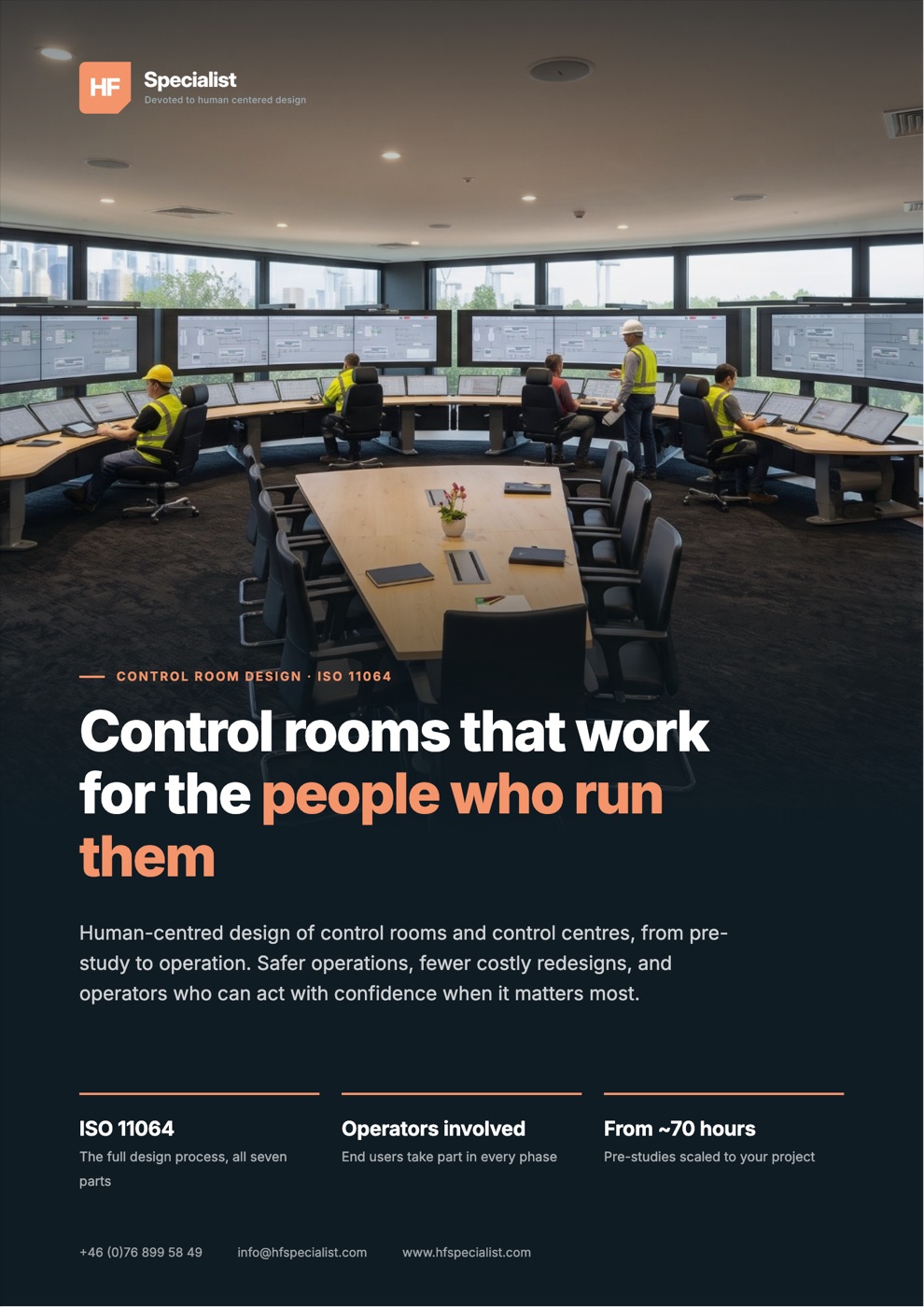
Control room design brochure, page 1 of 4

1 / 4

Our brochure

Control room design, on four pages

Everything in one place: why Human Factors matters in the control room, our ISO 11064 design process and what you get from each step, the services we offer and our pre-study plans.

Browse it here, or download it to share with your project team.

“If you think Human Factors is expensive, try an accident.”
An old saying in safety engineering

Planning a new control room or transforming an existing control centre?

Whether you are planning a new control room, consolidating several facilities into a central control centre, or modernising an existing operation, HF Specialist can support you throughout the Human Factors engineering and design process.

Let's discuss your project, operational challenges and how we can help create a control room that works for the people who operate it.